
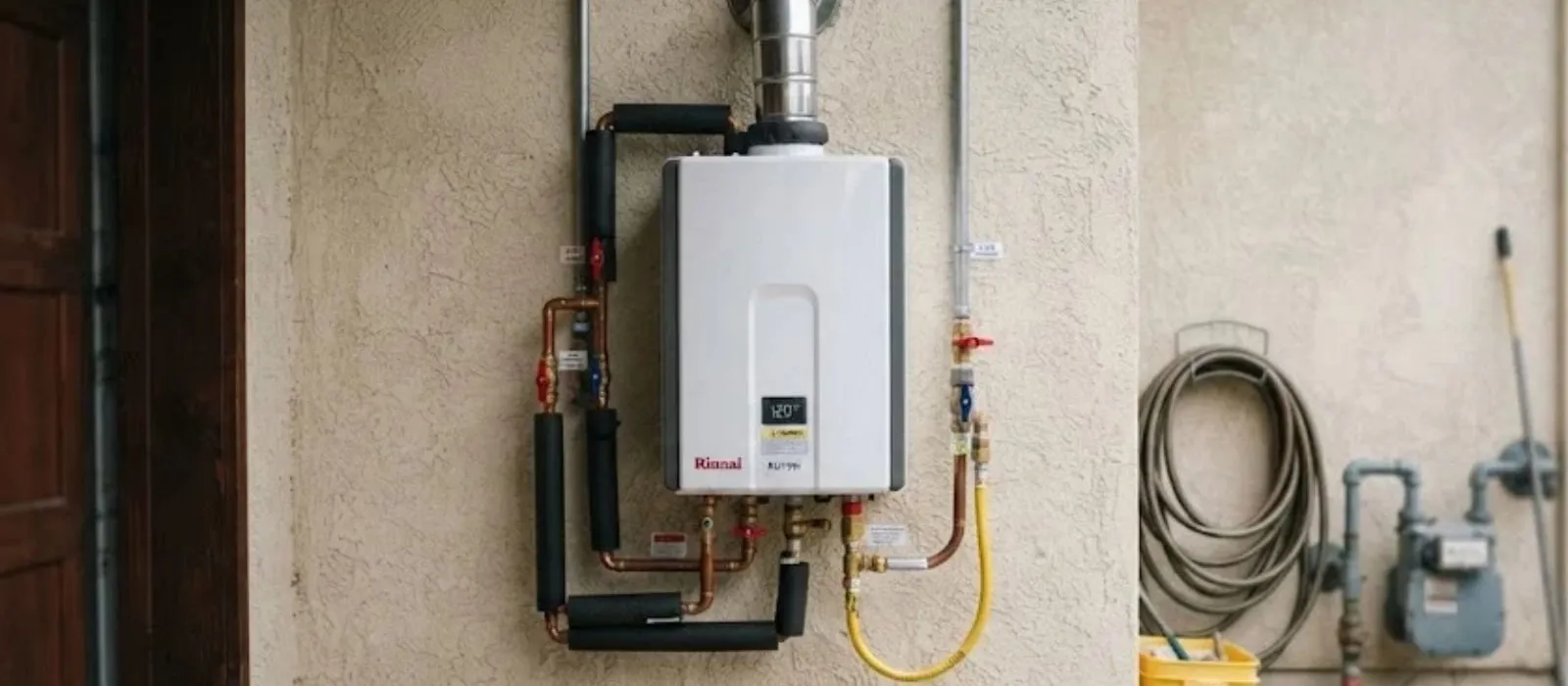
How a tankless heater works and what it asks of your house
A tankless water heater in La Mesa, CA heats water only when a tap opens, passing it through a heat exchanger instead of storing it in a tank. When flow starts, a sensor fires the burner or the electric elements, and the water leaves hot a few seconds later. There is no standing supply to run out, but there is a flow limit, and that limit shapes every decision about the unit.
The heater is only as good as its supporting systems: a gas line big enough to feed it, a vent path that clears exhaust, clean water through the heat exchanger and a unit sized to your fixtures. This page covers installing, repairing, flushing and sizing, and where homeowners can help.
Many callers tell us they just want an existing unit flushed or serviced, not swapped. Tell the dispatcher that on the call, because scale is behind a lot of poor tankless performance.
Tank or tankless: where each one wins
| Factor | Storage tank | Tankless |
|---|---|---|
| Hot water supply. | Runs out when the tank empties. | Continuous, but limited by flow rate. |
| Job size to install. | Smaller, often a straight swap. | Larger: gas line, venting, electrical or condensate work. |
| Standby heat loss. | Keeps a full tank warm all day. | None, since it heats on demand. |
| Typical service life. | Around 8 to 12 years. | Often 15 to 20 years with maintenance. |
| Maintenance | Flush and check the anode rod. | Descale the heat exchanger, clean the inlet screen. |
| When it fails. | A leak can flood the floor. | Usually an error code and a shutdown. |
| Space | Needs floor space. | Mounts on a wall. |
Tankless does not mean unlimited. Two showers and a dishwasher at once can exceed a unit's flow, and big households sometimes do better with a larger unit or two. If the job turns out to be larger than you want, a new tank installed on a planned schedule is a fair choice.
Descaling a tankless heater in very hard water
Helix reported an average hardness of 206 mg/L for 2025, which is 12.0 grains per gallon, with a range of 9.1 to 14.6. On the common USGS scale, that is very hard. Scale forms on a tankless heat exchanger faster than on a tank, because the water is heated hard and quickly, so La Mesa units collect it. Blends vary by street, so test your own tap.
A scaled-up heat exchanger moves heat poorly. The unit cycles more, gives temperature swings, shuts down on overheat or flow codes, and wears out the burner and sensors sooner. The fix is a descaling flush, and the manual for your model gives the interval. Some makers call for yearly service in hard water, so read your manual.
Signs that a flush is due include longer waits for hot water, hot and cold surges, a rumbling noise, a drop in flow and error codes tied to temperature or flow. A unit that has never been flushed is overdue, even if it still runs. Descaling is maintenance, and a flushed heat exchanger often returns to normal.
Need tankless water heater in La Mesa?
Call the line and describe what you see. A dispatcher takes it from there.
Vinegar flush or service flush: what is yours to do
A vinegar flush runs white vinegar through the heat exchanger with a small pump and two hoses on the service valves for about an hour, then rinses with clean water. It works only if the unit has isolation valves with flush ports. A service flush adds testing and safety checks that a hose and a bucket cannot.
Reasonable to do yourself
- Read the manual and note any error codes on the display.
- Clean the inlet water filter screen.
- Run a vinegar flush if the isolation valves are installed.
- Rinse the unit well and restore the valves in the right order.
Leave to a licensed plumber
- Any work on the gas line, burner or vent.
- Installing isolation valves on a unit that has none.
- Error codes that return after a flush.
- Checking combustion, flow rate and condensate drain.
- Leaks from the heat exchanger or fittings.
Tankless faults and error codes that need a closer look
Error codes differ by brand, so read your manual first. These are the groups most calls fall into, and a unit that repeats the same fault after a flush is a job for a proper repair visit.
Ignition failure
The burner will not light or will not stay lit. Causes include a low gas supply, a dirty flame rod or a failing igniter.
Flow or sensor faults
Hot water cuts out when you open a tap partway. A clogged inlet screen, scale or a weak flow sensor is the usual cause.
Exhaust or vent faults
A blocked vent, a bird nest on the termination or a cracked pipe trips a safety shutdown. This is a safety fault, so do not bypass it.
Overheat codes
Heavy scale on the heat exchanger traps heat and trips the high-limit sensor. A flush often clears it.
Condensate trouble
High-efficiency models produce acidic condensate. A blocked drain or a spent neutralizer can stop the unit.
Leaks
Water at the unit may be a loose connection, a failed valve or a cracked heat exchanger. Shut off the water and call.
Sizing a tankless heater by flow and temperature rise
Two numbers size a tankless heater. The first is flow, in gallons per minute, added up for the fixtures that run at once. A shower uses roughly 2 gallons a minute and a kitchen faucet a bit more than 1.
The second is temperature rise: the gap between the cold water entering the house and the temperature you want at the tap. Colder incoming water means a bigger rise and less flow from the same unit. We size for your coldest conditions, not an average day, so the shower stays hot in winter.
Gas line size and venting for a gas tankless
A gas tankless burner draws far more fuel per hour than a tank heater. The existing gas line to a water heater is often too small, so the pipe is sized by the unit's rated load and by how long the run is. A line that is too small starves the burner and sets off ignition or low-flame codes.
Venting depends on the model. Condensing units vent through plastic pipe with a sloped run and a drain for condensate. Non-condensing units need stainless or specified metal vent pipe. Terminations must stay clear of windows, doors and air intakes, and the manufacturer's installation manual sets the clearances.
What an electric tankless needs from your panel
Electric tankless heaters skip the gas line and the vent, but they draw a lot of power. A whole-house model can need several large breakers on 240 volt circuits, and the panel has to carry that load on top of the oven, dryer and air conditioning. Panel capacity, not the heater, is often the deciding factor. Smaller point-of-use electric units suit a single sink or shower without a panel upgrade.
How a tankless install is laid out
Load and flow check
We add up your fixtures, measure the gas line or panel and choose a unit that fits the real demand.
Fuel and vent prep
Gas line upsizing, the vent run or the electrical circuits are roughed in before the unit is mounted.
Mount with service valves
The heater goes on the wall with isolation valves and flush ports on the hot and cold lines, so future flushes do not require cutting pipe.
Commission and test
We check flow, temperature, combustion on gas units and the condensate drain, then walk you through the display and the maintenance schedule.
A softener or filter reduces the scale load on a tankless exchanger, which stretches the time between flushes. If hard water is the main complaint, a softener or filtration system may be worth pricing alongside the heater.
What decides tankless water heater pricing
Tankless work varies more than tank work, so the real number comes from a look at the gas line, the vent path and the panel. You get a clear price before work starts.
Install or service
A flush, a repair and a full install are different jobs with different labor.
Gas line upsizing
A longer run or a smaller existing pipe adds piping work.
Venting
A condensing unit with a long plastic vent run is different from a short metal vent.
Electrical capacity
A panel with spare room is easier than one that needs an upgrade.
Isolation valves and parts
Adding flush valves, a neutralizer or a replacement sensor changes the scope.
Homeowner policies often cover sudden and accidental water damage but often not wear, scale or planned upgrades, so ask your insurer about a leak claim before you assume.
Want your real number? Call (619) 927-0312
Call (619) 927-0312Tankless Water Heater questions answered
Some manufacturers recommend about once a year in hard water, and Helix reported very hard water for 2025, with an average of 12.0 grains per gallon. Your manual sets the exact interval for your model. If you have never flushed the unit, or you see temperature swings and error codes, do it sooner.
If the unit has isolation valves with flush ports, many homeowners do. You need a small pump, two hoses and white vinegar, and the circulation runs about an hour. If the valves are missing, if the gas or vent is involved or the codes return, call a licensed plumber.
Codes are brand specific, so the manual or the label inside the front panel tells you the meaning. Most fall into ignition, flow, vent, overheat or condensate groups. Write down the code, try one power reset and clean the inlet screen. If it comes back, call with the code and the model number.
It can be, but flow is the limit. A family running two showers and a dishwasher at once may need a larger unit, or two units, to keep temperature steady. A tank can be the simpler choice in a house with long hot demand and a tight gas line. We size from your real fixtures.
Often, yes. A tankless burner draws much more fuel than a tank heater, and the old line may be too small for the run. The correct size depends on the unit's rated load and the length of pipe. We measure the line before choosing a model.
Maybe. A whole-house electric tankless can use several large circuits, and the panel has to carry them along with the rest of your home. We check the panel before you buy. A smaller point-of-use unit often fits without a panel change.
Yes. We take tankless calls in La Mesa and in El Cajon, and the dispatcher can tell you what is available the same day. Share the brand, the model and any code on the display, and say whether you want a flush, a repair or a quote on a new unit.
Standards and sources
Tankless units are installed to the manufacturer's installation manual and to the California Plumbing Code, which is based on the Uniform Plumbing Code (UPC). The manual sets venting type, gas line size and clearance for the exact model.
Helix Water District reported an average hardness of 206 mg/L for 2025, which is very hard on the common USGS scale. Check your unit's manual for the service interval it recommends in hard water.
Tankless Water Heater beyond La Mesa
The same dispatch line covers neighboring towns. Pick yours to see local notes.