
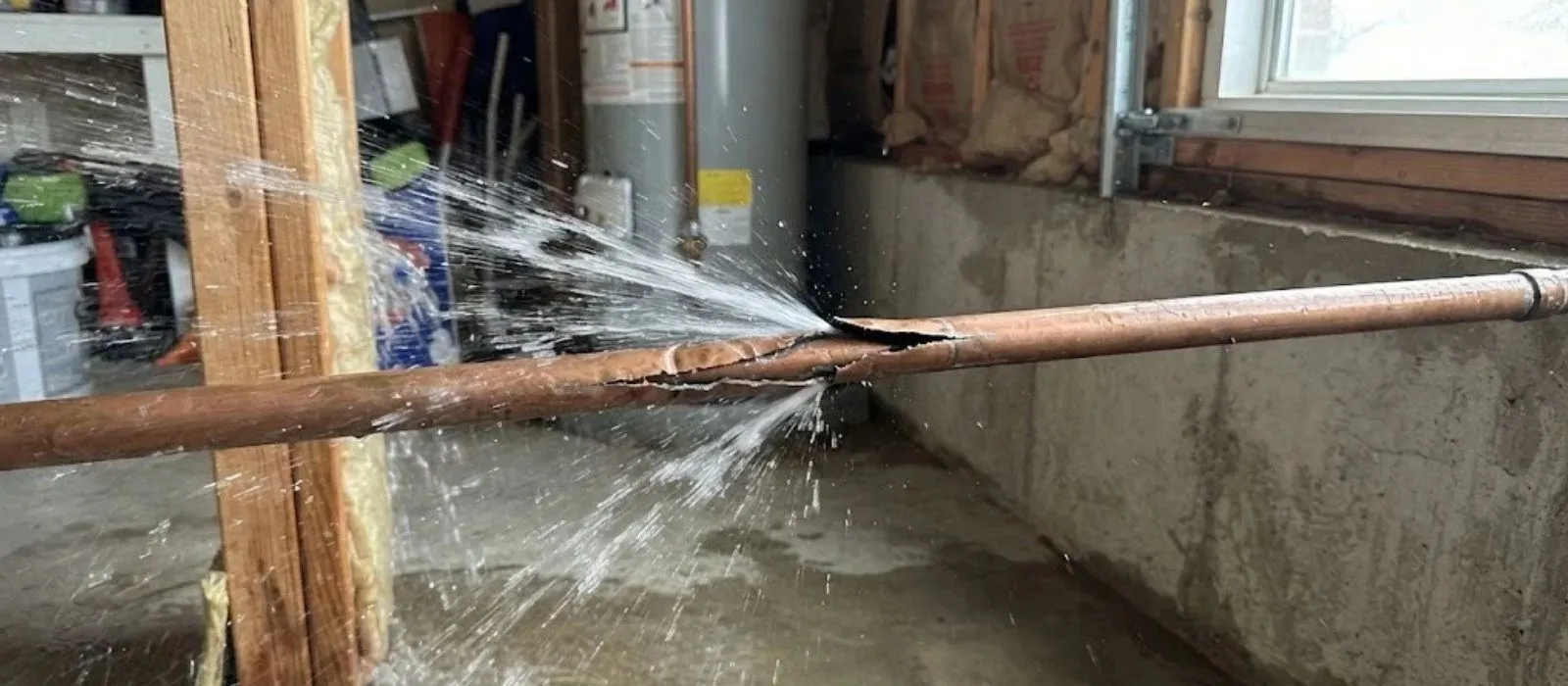
What a burst pipe repair actually involves
A burst pipe is a split, crack or blown fitting that lets water out faster than any drip. If one has opened up in your La Mesa, CA home, our 24/7 line is open, and the next minute counts for more than anything else on this page. Stop the flow first, then read on while you wait.
Callers describe it in plain terms. Water sprays from a wall, runs behind the fridge in the garage or pours from a cracked elbow. Sometimes an old galvanized pipe simply gives way. This page covers what to do right away, why pipes break here, and how each pipe material gets repaired.
A pipe just burst: the first 60 seconds
Water damage compounds quickly, so move first and think second. Our 24/7 plumbers work nights and weekends, and we can stay on the phone while you go through this list.
- Close the main shutoff on your house plumbing. A lever handle is closed when it sits crosswise to the pipe, and a round wheel turns clockwise.
- If the leak is near the panel, an outlet or a light fixture, stay out of the water and call 911 if you see sparks. Otherwise switch off the breakers for that area.
- Open the lowest faucet in the house to drain what is left in the pipes and take pressure off the break.
- Turn off the water heater, either the breaker or the gas control set to pilot, so it does not heat an empty tank.
- Soak up water with towels, a mop or a shop vacuum and move belongings out of the wet zone.
- Take photos before you clean up.
Why pipes split open in a mild climate
La Mesa winter highs average 66 to 77 F, so freezing is not the usual cause here. That points your search toward the four causes below.
Corrosion
Pipes thin out from the inside or outside until one weak point opens. Pinholes along a run say the whole run is wearing.
Pressure and surges
High pressure strains every joint. A hard water-hammer bang when a valve shuts can crack an old fitting.
Age and brittleness
Old galvanized steel clogs and rusts through. Aged CPVC can turn brittle and crack at a fitting without warning.
Accidental damage
A nail through a stud, a drywall screw or a trench dug too close can nick a line, which later splits.
Poor joints
A badly soldered or glued fitting can hold for years and then let go all at once.
Need burst pipe repair in La Mesa?
Call the line and describe what you see. A dispatcher takes it from there.
A crack in the pipe or at a fitting: the repair itself
Most breaks are fixed by cutting out the damaged section and splicing in new pipe with the right couplings. We locate the full extent of the crack first, then cut back to sound pipe on both sides. A short clamp over a split can slow the leak, but it is a stopgap, not a lasting repair.
A cracked PVC connector or a split elbow is replaced as a unit, since the fitting is the failure. We then look at the pipe next to it. If it is brittle or heavily corroded, a longer replacement avoids a second break next month.
After the new section is in, we turn the water on slowly and check each joint under pressure. You also get a clear price before any cutting starts.
How the fix differs by pipe type
| Pipe | How it usually fails | Typical repair | Watch for |
|---|---|---|---|
| Copper | Pinholes, split from corrosion, loose solder joint. | Cut out and sleeve or solder in new copper, or use push fittings. | Pinholes elsewhere on the same run. |
| PEX | Crushed or kinked line, failed crimp ring, nail damage. | Cut and join with PEX fittings. | Kinks near bends in tight spaces. |
| Galvanized steel | Rusted through at threads and bends. | Replace sections, often with other pipe. | Low pressure from rust inside. |
| CPVC | Brittle crack at a fitting or along the pipe. | Cut and replace with CPVC or transition fittings. | More cracks in the same run. |
| Cast iron drain. | Cracked or corroded wall, failed joint. | Replace the section with no-hub couplings. | Leaks that only show when you drain water. |
Where a pipe is galvanized or CPVC and showing more than one failure, ask about replacing the entire run rather than patching.
Pinholes, copper joints and cracked drain lines
A small spray or a single dripping spot is a pipe leak, not yet a burst. Do not wait on it. Pinholes tend to widen, and the damage behind a wall keeps building even when the drip looks minor.
Copper is the classic case. A half-inch line may spray fine mist from a pinhole, or an old soldered joint behind a shower valve may let go. We fix it with a cut-in sleeve, a new soldered coupling or a push-fit connector.
Drain pipes crack too, and they leak only when water runs through them. A wet area below a toilet or in the garage points to a cracked drain, and we repair it by cutting out the section and fitting a new one. If the crack is on the line toward the street, it becomes sewer line work and a camera look comes first.
What happens once the plumber is at your door
Confirm the water is off and the area is safe
We check the valve, the electrical risk and where the water is traveling.
Open only what is needed
A small access cut in drywall or a floor panel exposes the break. We avoid cutting more than the repair needs.
Cut back to sound pipe
The failed section comes out, and we judge how far the damage extends along the run.
Install, pressure test and check
New pipe goes in, the line is pressurized, and we look at each joint for weeping.
Advise on drying
We tell you what should dry on its own and what needs a fan, a dehumidifier or removal.
Leaks that need a repair but are not an emergency yet
Not every leak is a gusher. A slow drip under a sink, a weeping valve or a damp spot in a closet can wait for a scheduled visit if the water is shut off to that fixture. Close the small stop valve under the sink or at the fixture and keep the rest of the house running.
If you cannot tell where the water comes from, a hidden leak search tells us the spot before any wall is opened. In a condo or rental, tell the property manager or landlord, since the break may be on a shared line.
Documenting the break for your insurer
Photograph the break, the wet areas and the damaged belongings before you clean up. Keep the failed pipe section in a bag. If the plumber can say whether the break was sudden or from slow corrosion, ask for that in the written invoice.
Call your insurer soon and ask what they want to see before repairs. Many policies expect you to limit further damage, so shutting the water and drying the area are part of the claim. Keep receipts for fans, hauling and cleanup, and do not throw away soaked materials until the adjuster has looked.
Find your main shutoff now and close it once to be sure it moves. A valve that has not turned in years may seize. Tag it with a bright label so anyone in the house can find it in the dark.
What goes into the price of a burst pipe repair
We give you a written price before work starts. These factors move it.
Pipe material and size
Copper, PEX, CPVC and cast iron each take different parts and labor.
How hard the break is to reach
A pipe in an open garage wall is easier than one inside a finished bathroom wall.
Length of pipe that must be replaced
One split elbow is a short job. A corroded run needs more pipe.
Access and restoration
Opening and patching drywall, tile or flooring is separate from the pipe repair.
Water cleanup and drying
Extraction and drying equipment add cost when water has spread.
Homeowner policies often cover sudden and accidental breaks and the resulting damage, but often not gradual leaks or wear. Your insurer can tell you what applies to your policy.
Want your real number? Call (619) 927-0312
Call (619) 927-0312Burst Pipe Repair questions answered
Yes. Our line is open 24/7, including nights and weekends. Close your main valve, open the lowest faucet and call (619) 927-0312. We will help you limit the damage by phone and arrange a same-day visit when one is available.
Yes, if you drained the lines. Switch off the breaker or turn the gas control to pilot. A heater element or burner that runs with an empty tank can be damaged.
A repair clamp or a rubber-and-clamp wrap can slow a split for a short while. It is a stopgap. The damaged section should be cut out and replaced as soon as you can schedule it.
Freezing is uncommon in La Mesa, so look at corrosion, pressure and damage first. An old galvanized line, brittle CPVC or a pipe nicked during other work are common reasons.
It depends on what is already in the wall. We match the existing material with proper fittings or use approved transition fittings. For a run with repeated failures, the better question is whether to replace the whole run.
Run fans and a dehumidifier and keep the room ventilated. Wet insulation and soaked drywall often need to come out. If drywall stays damp for more than a day or two, mold becomes a concern.
Yes. We cover La Mesa and nearby areas such as Spring Valley with the same 24/7 emergency line.
Not quite. A leaking joint is a slow weep and a burst is a sudden failure. Both need repair, and a weeping joint often gets worse, so address it early.
Standards and sources
A burst pipe call starts with the main shutoff valve. The California Plumbing Code, based on the Uniform Plumbing Code (UPC), covers the pipe materials and fittings used in the repair.
After the water is off, take photos and call your insurer. Verify any plumber's license at cslb.ca.gov, and ask for the price in writing before work starts.
Burst Pipe Repair beyond La Mesa
The same dispatch line covers neighboring towns. Pick yours to see local notes.