
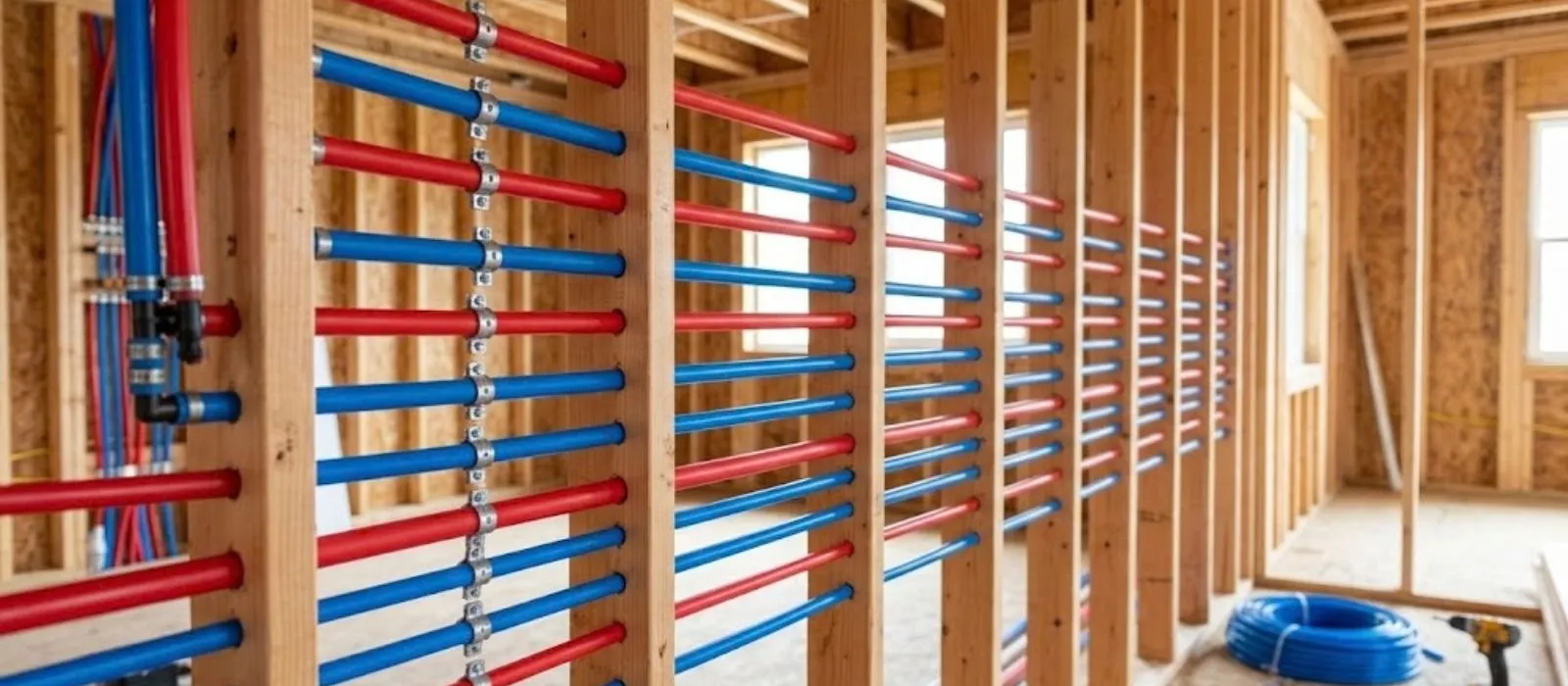
What repiping replaces and what it leaves alone
Repiping means replacing the water supply pipes inside your house, from the main valve to every faucet, shower, toilet and appliance. In La Mesa, CA it is planned work, which gives you time to compare materials and schedules instead of reacting to a flood. We start with a look at what you have now and where it is failing.
It does not include the buried pipe from the street. That is a separate job covered under replacing the underground service line. It also does not cover drain pipes, which carry waste out, unless you ask for them specifically.
Signs your supply lines are near the end
One leak does not mean a repipe. A pattern does.
Rusty or brown water
Water that runs brown when you first open a tap, mostly from older galvanized steel, means rust is shedding inside the pipe.
Low flow at several fixtures
Weak flow in many places, especially at the far end of a run, can mean the pipe bore has narrowed.
Pinhole leaks that keep coming back
Fix one and another opens a few feet away. Each repair costs money and rarely stops the pattern. A hidden one may need a leak search to locate.
Galvanized pipe of any age
Galvanized steel corrodes from the inside and can clog long before it leaks.
A brittle plastic pipe
CPVC that cracks near fittings or breaks when touched shows its age. Replacing it before it breaks avoids water damage.
Copper, PEX or CPVC: an honest comparison
| Material | Strengths | Limits | Good fit |
|---|---|---|---|
| Copper | Long record of service, rigid, handles heat, safe outdoors. | Pricier, more labor, can pinhole in some conditions. | Exposed runs and buyers who want a traditional pipe. |
| PEX | Flexible, fewer joints, quick to pull through walls. | Damaged by sunlight, so it must stay covered. | Whole-house jobs with tight access. |
| CPVC | Stiff plastic, does not rust, lower material cost. | Can turn brittle with age and heat, less forgiving. | Budget-minded jobs with straight runs. |
No pipe is perfect. PEX is the most common choice for whole-house jobs because it goes in with fewer wall openings, while copper is a solid pick where pipe is exposed. We tell you what we would install in your walls and why.
Need repiping in La Mesa?
Call the line and describe what you see. A dispatcher takes it from there.
What to do before a repipe crew arrives
Locate the main shutoff
Know where it is and test that it turns. The crew will close it, and a stuck valve is better found beforehand.
Clear access
Empty cabinets under sinks, closets with water heater or manifold access and the path to the attic or crawlspace.
Protect valuables
Move electronics, rugs and framed items out of rooms where walls may open. Cover furniture you cannot move.
Plan for water off
Store drinking water, fill a few buckets for toilets and arrange where to stay if the water will be off for most of a day.
Replacing galvanized steel before it fails
Galvanized pipe is a steel pipe coated with zinc, and the coating wears away over decades. Inside, rust builds up and narrows the pipe. Pressure falls, the water tints brown and eventually a thread or elbow gives way.
Callers also ask about CPVC lines they want replaced before they crack. That is a reasonable plan when the plastic is aging and has a history of breaks. A repipe lets you swap the whole network on your schedule, not at 3 am after a pipe has already burst.
Reading the water report with your pipes in mind
Helix Water District reported 2025 hardness averaging 12.0 grains per gallon in the distribution system, which is very hard on the common scale. Hard water leaves mineral scale inside hot water lines and fixtures. When we open an old line, we look at how much scale has narrowed it and whether the next section is the same.
Helix also reported an average pH of 8.3. We make no claim about what that does to your specific pipes. If scale is the issue, softening or filtering the incoming water is a separate decision you can weigh alongside the new pipe material.
Phased repiping or the whole house at once
Phased approach
- Replace the worst runs first, such as the kitchen and bathrooms.
- Spreads the cost and disruption over time.
- Leaves some old pipe in service.
- Needs a plan so old and new tie together properly.
Whole-house approach
- One project, one set of wall patches.
- All lines on one material and one schedule.
- Longest stretch without normal water use.
- Best when leaks and rust appear throughout.
From the first walkthrough to the last patch
Walkthrough and plan
We trace the existing lines, note where access is easy and where walls are tight, and write out the routing.
Prepare the home
Clear closets and the space under sinks. We cover floors and mark where wall openings will go.
Run the new lines
New pipe is pulled through the attic, crawlspace or wall cavities, with the openings kept as small as the route allows.
Cut over and test
The old lines are disconnected and the new ones tied in. Then we pressure test and flush the system.
Patch and clean up
Access holes are closed and the house is cleaned. Texture and paint matching is a separate step we discuss up front.
Drywall access, patching and what finish work to expect
New pipes need paths. In a house with an attic or crawlspace, many runs can be pulled overhead or underneath with small holes at the fixtures. In a slab-on-grade house, lines that were under the floor are often rerouted through the attic and down the walls.
Plumbers close the access holes with drywall patches. Smoothing, texture and paint are finishing steps that may be a different trade. Ask what is included in the written price so there are no surprises when the dust settles. Tile and plaster walls take extra care, and we point those out before cutting.
Checking with the city before work begins
Permit rules vary, so ask the City of La Mesa building staff before work starts. City Hall is at 8130 Allison Avenue, and the main line is 619-463-6611. Hours run Monday to Thursday, 7:30 am to 5:30 pm, and Friday, 7:30 am to 4:30 pm, with City Hall closed on alternate Fridays, so call early in the week.
You can verify any plumber's license on the California Contractors State License Board site at cslb.ca.gov. Do that before signing anything.
Living in the house while the pipes change
Expect water to be off for part of the job. Plan for showers elsewhere, bottled drinking water and a kitchen that works without a sink for a stretch. We give you the schedule for each water-off window ahead of time.
Dust, noise and strangers in the house are part of the deal. Move valuables, secure pets and keep someone available for access. For a large house, a phased plan can keep a working bathroom and kitchen running.
Take a few photos of the stains, the rusty water in a clear glass and any past repair spots. Note which fixtures run weak. That record shortens the diagnosis.
What shapes the price of a repipe
The real number comes after a walkthrough of your house.
Size of the house
More fixtures and more pipe mean more labor and material.
Pipe material
Copper, PEX and CPVC each have different costs for parts and labor.
Access
Open attic and crawlspace routes are faster than closed walls.
Wall and floor repair
Patching, texture, paint and tile work add to the project.
Phasing and permits
A phased plan changes the number of visits, and permit handling depends on local rules.
Homeowner policies often cover sudden and accidental water damage but often not wear or planned pipe replacement. Ask your insurer if a covered leak makes any of the work eligible.
Want your real number? Call (619) 927-0312
Call (619) 927-0312Repiping questions answered
One leak on sound pipe is a repair. Repeated pinholes, rusty water and low flow across several fixtures point to a repipe. We look at the pipe age and material to give you a straight answer.
It depends on access, budget and what is in the walls now. PEX goes in with the fewest openings, copper suits exposed runs and CPVC is the lowest-cost rigid option. We explain our reasoning for your house.
Usually yes, with planning. Water will be off for part of the work, so arrange showers, drinking water and cooking around it. A phased plan can keep one bathroom and the kitchen working.
Yes, small access holes are needed. We patch them, and we tell you up front whether texture and paint are included. Tile and plaster take extra care.
Permit rules vary, so ask City of La Mesa building staff before work starts. We can help you with what to ask when you call.
Close the main valve and call. Our emergency line is open after hours for sudden leaks, and a repair can hold while the larger project is planned.
If the galvanized runs are the only old pipe, replacing them can be enough. If the rest of the house shows wear, one project costs less in disruption than several separate ones.
Yes, we also plan repipes in nearby areas such as El Cajon. The walkthrough, the material choice and the written price work the same way wherever the house is.
Standards and sources
Whole house repiping in California follows the California Plumbing Code, based on the Uniform Plumbing Code (UPC), for approved materials and sizing. Ask which pipe material is proposed and why before you agree.
Permit and inspection rules vary, so ask City of La Mesa building staff before work starts. Verify any plumber's license at cslb.ca.gov.
Repiping beyond La Mesa
The same dispatch line covers neighboring towns. Pick yours to see local notes.