
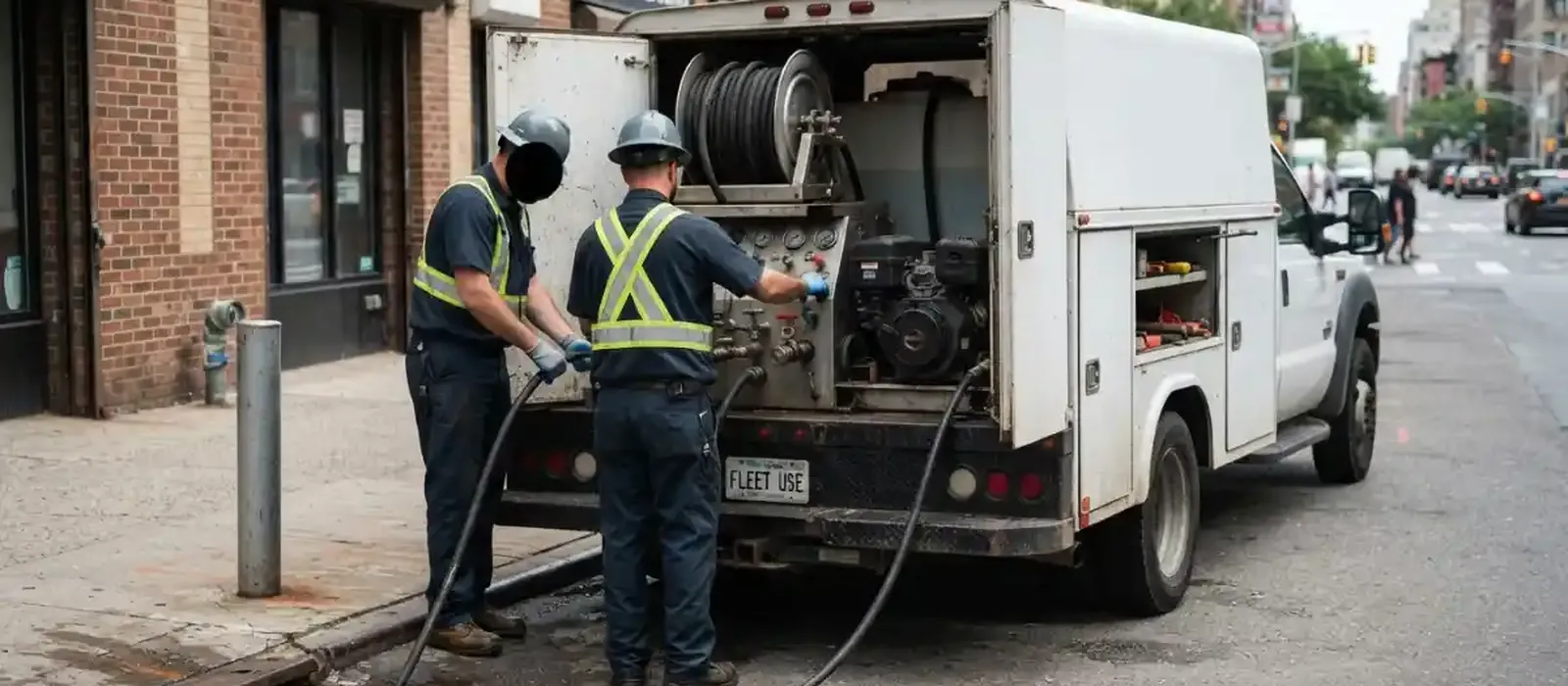
Main sewer line cleaning in plain terms
Sewer line cleaning is the removal of grease, paper, roots and debris from the large pipe that collects every drain in the house and carries it to the street. If sewage is backing up in La Mesa, CA, call our 24/7 emergency line at (619) 927-0312 and stop using water right away. A licensed plumber takes it from there.
The main line is usually four inches wide and runs from the house, under the yard, to a connection at the street. It has one job, so when it fails every fixture fails. That is why symptoms show up in several places at once.
This page covers clearing that pipe. Cleaning does not repair cracks, so a camera pass is often part of the visit.
Which service fits your problem
Three pages on this site sound alike but cover different jobs. This is the quick way to choose.
Main line cleaning fits when
- Several fixtures back up together.
- A toilet gurgles when the washer drains.
- A floor drain or basement tub bubbles.
- Slow flow returns after every cleaning.
Look at another service when
- One slow sink or tub is a job for fixture-level drain cleaning.
- A cracked or collapsed pipe needs a pipe repair instead.
- A line of unknown condition calls for a camera first.
Signs the main line is closing up
Several fixtures slow together
A tub, toilet and sink on the same level that all drain badly share a line, and that line is the problem.
A gurgling toilet
Water leaving a sink or the washer pulls air through a toilet trap when the main is partly blocked.
Floor drain bubbling
The lowest drain in the house is usually the first to burp when the main stalls.
Tub rising when you flush
Water that appears in the tub after a flush has nowhere else to go.
Relief that fades
If each cleaning helps for a shorter time, something in the pipe is changing, such as growing roots.
Need sewer line cleaning in La Mesa?
Call the line and describe what you see. A dispatcher takes it from there.
Sewage backing up into a bathroom or basement
Raw sewage on the floor is a cleanup problem and a health problem, and every minute of water use adds to it. Night and weekend calls get a cable at the cleanout first so the flow returns. A longer job such as jetting can be booked for a same-day slot when available.
- Shut off water use at every fixture, not only the one that is flooding.
- Clear the area around the cleanout cap but leave it closed, because pressurized sewage can rush out when it opens.
- Wear gloves, boots and a mask for any cleanup before the line is open.
- Tell everyone in the house not to flush, even once.
- Move electronics and boxes up off the floor, and run a fan once the water has dropped.
What to do and what to avoid when sewage backs up
Stop adding water
Skip laundry, dishwashers and showers. Every gallon you run goes to the lowest open drain in the house.
Avoid contact
Wear boots and gloves if you must cross wet floors, and keep children and pets away. Wash hands well afterward.
Do not use harsh chemicals
They do not clear roots or grease from a main line and they make later work more hazardous.
Photograph and document
Take photos of the affected areas before cleanup. Your insurer may ask for them.
Finding the cleanout on your property
A cleanout is a capped pipe, usually three or four inches wide, that gives a plumber direct access to the sewer line. Look outside along the house wall near the bathrooms or kitchen, near the property line close to the street, or in a garage or basement floor. The cap is often round with a raised nut on top.
If you cannot find one, check the lowest point of the house. Without a cleanout, a plumber may have to go in through a toilet, which means pulling it and setting it again. A cleanout makes every future visit faster and keeps sewage out of the house, so adding one is worth asking about.
Mark the spot with a small stake or a dab of paint so you can point to it. Keep plants and stored items off the cap.
Cable or water jet for a main line
| Situation | Cable | Water jet |
|---|---|---|
| First stoppage with paper or a soft clog. | Usually enough | Not needed |
| Grease coating the pipe wall. | Opens a channel only. | Better choice |
| Roots in a joint. | Cuts the main mass. | Cleans the wall afterward. |
| Line clogs every year or two. | Short-term fix | Longer result on sound pipe. |
| Pipe condition unknown. | Safe starting tool. | Camera first |
For how the water method works and when it is the wrong call, read about hydro jetting for lines that keep clogging.
After the backup: stopping it and keeping it stopped
The first goal is to open the line from the cleanout so wastewater leaves your house. A machine cable with a cutting head goes in until it reaches the blockage, which might be paper, grease or a ball of roots. When the cable breaks through, you can see the standing water drop.
Do not stop there. The second goal is to learn why the line failed. A short camera pass after cabling shows whether roots are entering at a joint, whether the pipe sags, or whether the clog was a one-time event.
If the camera finds damage, cleaning is only temporary and the next conversation is about repair. If the pipe is clean and sound, a cleaning schedule keeps you ahead of the next one.
What the plumber does once the cap comes off
Protect the area
Drop cloths go down and the cap is opened slowly, in case the line is under pressure from backed-up water.
Run the cable
The cutting head is fed in toward the street until it meets the blockage, then worked through it.
Flush and watch
Water runs through the opened line while we watch the cleanout and the lowest fixture to confirm steady flow.
Camera if needed
When the cause is unclear, a camera goes in to record the pipe, and you decide on any next step.
Main sewer cleaning and sewer drain cleaning
Main sewer cleaning targets the pipe from the house to the street. The cable or jet runs the full length, and we check that water poured in at the cleanout leaves at a steady pace.
Sewer drain cleaning is how many callers describe a drain that is backing up into bathrooms and needs to be cleared. It is the same work with the same tools and starts at the same cleanout. What changes is how far the blockage sits.
How often a sewer line should be cleaned
A healthy line with no roots and no grease trouble may never need scheduled cleaning. A calendar makes sense only when the line has a history. If it has stopped twice in a few years, think about a cleaning every year or two, with a camera look at the same visit.
Large trees near the line, older pipe and a kitchen that sends fat down the drain all shorten the interval. A planned visit costs less in disruption than an emergency call, because nothing has flooded. Homeowners in Spring Valley and across La Mesa use the same approach.
What goes into the price of cleaning a sewer line
The price depends on what is in the line and how easy it is to reach. You get a clear price before work starts.
Length and access
A line with a cleanout near the house is quicker than one that needs a toilet pulled.
What is blocking it
Soft paper clears fast. Roots and packed grease take more passes.
Cable or jet
Jetting uses different equipment and more time than a cable.
Camera pass
A recording before or after adds time and shows what was removed.
Hour of the call
Overnight and weekend calls are priced differently from a planned weekday visit.
Policies often cover sudden and accidental backup damage only if a sewer backup endorsement is on the policy, and often not gradual buildup or wear. Ask your insurer before the cleanup starts.
Want your real number? Call (619) 927-0312
Call (619) 927-0312Sewer Line Cleaning questions answered
Yes. Sewage in the house is handled as an emergency at any hour. We open the line from the cleanout to stop the backup, and book longer work such as jetting as a same-day appointment when available. Call (619) 927-0312 and tell us which fixtures are affected.
Water from the washer travels down the same main line. If the pipe is partly blocked, the draining water pulls air through the nearest trap, and the toilet gurgles. It is an early warning, and a cleaning now is easier than one after a backup.
Look for a capped pipe three or four inches wide. Common spots are along the house wall near the bathrooms, near the front edge of the yard, or on a garage or basement floor. If you cannot find it, describe the layout on the phone and we will help.
A cable cuts the main root mass quickly. A jet then cleans the pipe wall and flushes small roots, if the pipe is sound. Roots return wherever a joint is open, so a line with roots every year may need a repair at that joint.
Only if the line has a history of stopping. After two backups in a few years, many homeowners pick every year or two. A camera look shows how fast the line is changing, and we can adjust the schedule honestly from that.
If standing water shows at your own cleanout, the blockage is on your side or just past it. Ask the City of La Mesa which part of the line is public. We clear the part on your property and tell you what we found.
Standards and sources
Main line cleaning is done with a cable or a jetter through a cleanout. Cleanouts are the access points that let a plumber reach the line without opening a wall, and the California Plumbing Code is based on the Uniform Plumbing Code (UPC).
Ask the City of La Mesa which part of the sewer lateral is public. A cleaning cannot fix a collapsed or offset pipe, and a camera shows whether that is the cause.
Sewer Line Cleaning beyond La Mesa
The same dispatch line covers neighboring towns. Pick yours to see local notes.