
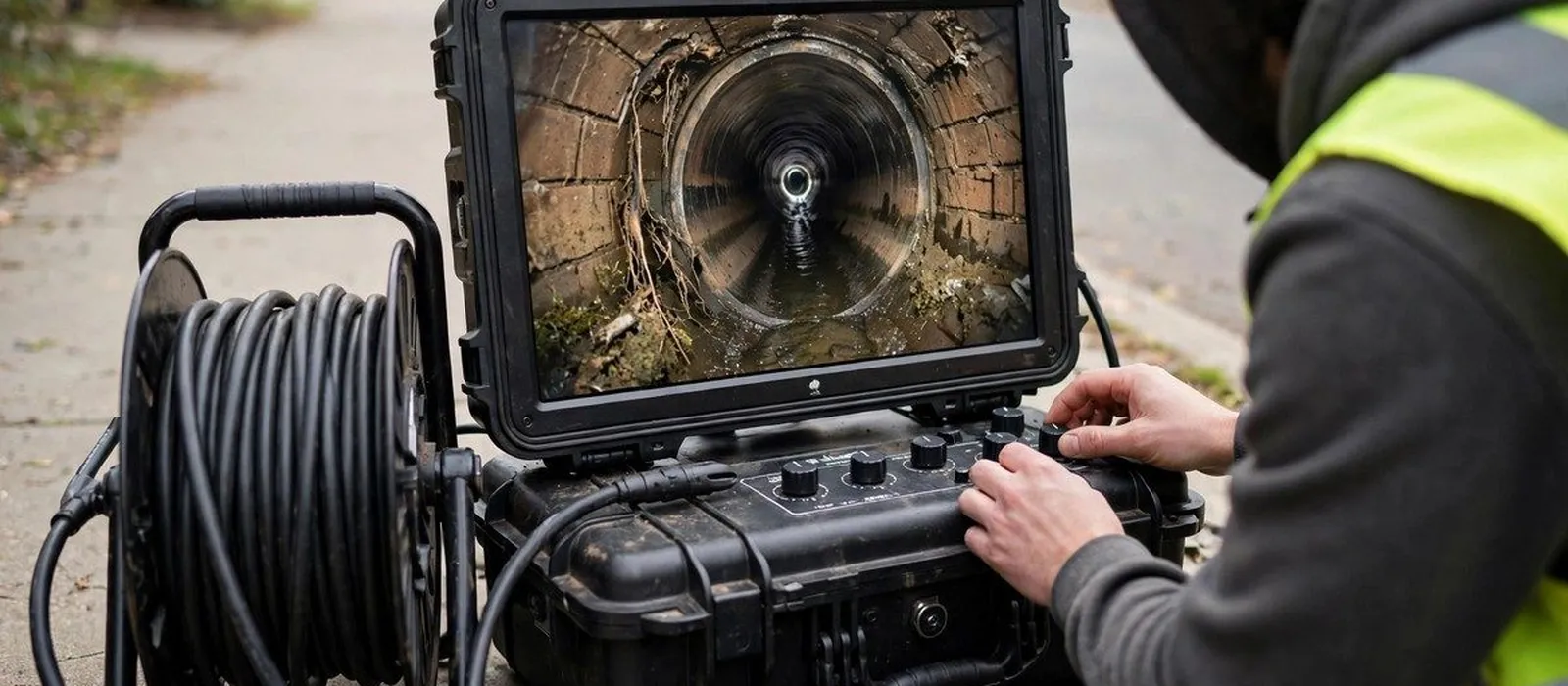
A look inside the pipe before you spend money on it
A sewer camera inspection is a recorded look inside the drain line, made by feeding a waterproof camera on a push rod through a cleanout. For homes in La Mesa, CA it is planned work, and most people book one because of repeat clogs, a home purchase or a line that has never been checked.
The camera sees what a cable can only feel. A cable tells us something is in the way. The camera shows whether that something is grease, roots, a dropped object or a crack, and that difference decides whether you need cleaning, repair or nothing at all.
Ask to go through the footage as it plays, so you can ask questions at each point where the pipe changes.
What the camera can show you
Roots
Fine threads at a joint or a thick mass across the pipe. Both mean moisture is escaping somewhere.
Cracks and breaks
A dark line along the pipe wall, or a gap where a section has split or fallen away.
Offset joints
Two pipe ends that no longer line up. They catch debris and let roots in.
Sags
A low stretch where water sits instead of flowing. Waste settles there and clogs form.
Scale and buildup
Rough, flaking walls or a coating of grease that narrows the opening.
Material and branches
Whether the pipe is cast iron, clay or plastic, and where other lines join it.
Finding where the line runs and where the trouble sits
Many callers just need to know where the line goes. The camera head carries a transmitter, and a locator held above ground picks up its signal. That gives the position and depth of the pipe and the distance from the cleanout to any damage. We mark the route with paint or flags.
This matters before you plant a tree, pour a patio or dig a trench. If a repair is needed, it also limits how much ground has to be opened. When there is no cleanout, access may be through a toilet or a roof vent, so mention that when you call.
Need sewer inspection in La Mesa?
Call the line and describe what you see. A dispatcher takes it from there.
How an inspection goes
Find the way in
We locate the cleanout and check its size. If none is there, we choose the next best access point.
Clear the view
A camera cannot see through packed grease. If the line is heavily blocked, a quick cable pass comes first.
Run the camera
The camera moves at a slow walking pace and stops at anything unusual. Distance marks on the rod tell us how far each problem sits.
Review the footage
We replay the key moments, explain what you are seeing and talk through the options. You decide what happens next.
If you are buying or selling a house
A general home inspector usually cannot see a buried sewer line, and a clean flush test does not prove the pipe is sound. Buyers use a camera inspection to check for roots, cracks and sags before closing. If the video shows damage, you can raise it with the seller while you still have room to negotiate.
Sellers use one to learn what a buyer's inspector might find. Fixing a short bad section before listing is often simpler than arguing about it afterward, and a clean recording gives a buyer something concrete to review.
Older homes are more likely to have older pipe materials, but age alone proves nothing. Only the video does.
When the same drain keeps stopping
After a third clog, cleaning alone stops being a sensible use of your money. A camera looks for the cause, whether that is roots at a joint, a sag where waste settles or a crushed section. If it is plain buildup in sound pipe, a high-pressure water pass that scours the pipe wall may end the cycle.
If the pipe is damaged, jetting could make matters worse, and the better step is a repair. In between sits routine cleaning of the main line on a schedule, which the footage helps you set honestly.
What you see on screen and what it usually means
| On the screen | What it usually is | What happens next |
|---|---|---|
| Fine threads at a joint. | Root intrusion | Cut and clean, then judge the joint. |
| A dark line along the pipe. | A crack or split. | Spot repair or lining, depending on length. |
| Water pooling in a low stretch. | A sag or belly. | Repair if it holds waste, monitor if shallow. |
| Rough, flaking walls. | Scale or corrosion. | Cleaning, then a check of wall condition. |
| Pipe ends not lined up. | An offset joint. | Repair, since it catches debris and admits roots. |
A single frame can mislead, so we pause on each finding and look at the pipe before and after it.
What a smoke test is for
A smoke test pushes non-toxic, visible smoke into the sewer line while the ends are closed off. Wherever smoke escapes, there is an opening such as a cracked vent, a missing cleanout cap or a broken connection. It finds leaks a camera may not reach.
Smoke does not show how far a pipe is damaged, so it complements the camera and does not replace it. Not every house needs one. We suggest it when odors point to an opening but the video looks clean.
What the findings lead to
If the pipe is sound, you have a baseline recording. Keep it, because a clog two years from now can be compared with this footage to show what changed.
If the video shows buildup or minor roots, cleaning is usually the answer. If it shows a break, a spot repair, lining or replacement of the damaged section is the conversation, and you get the price in writing first. We schedule inspections across La Mesa and in neighboring El Cajon.
What affects the cost of a camera inspection
Inspections are planned visits, and same-day appointments are offered when available. You get a clear price before work starts.
Access
A cleanout makes it quick. Going in through a toilet or vent takes longer.
Length of the line
A short run to the street takes less time than a long line with several turns.
Cleaning first
A line coated with grease may need a cable pass before the camera can see anything.
Locating and marking
Tracing the route and depth above ground is extra work that many customers want.
Added tests
A smoke test or a second camera pass adds equipment and time.
Insurers rarely pay for an inspection itself, since it counts as maintenance or purchase checking. A recording that shows sudden damage can support a claim, so ask your insurer what they need to see.
Want your real number? Call (619) 927-0312
Call (619) 927-0312Clear the cleanout cap, note which fixtures clogged and when, and ask the City of La Mesa which part of your line is public.
Sewer Inspection questions answered
It depends on the length of the line, how many bends it has and whether it needs cleaning first. The camera moves at a slow walking pace and stops at every finding. Tell us the house size and layout when you call and we can plan the visit properly.
A push-rod camera is flexible and small, and it moves gently through sound pipe. If the pipe is badly collapsed, the camera simply stops where it cannot pass, and that stopping point is a finding. We never force it.
Usually yes. Access can come through a pulled toilet or a roof vent, which adds some time. Adding a cleanout while we are there is worth discussing, because it makes every future inspection and cleaning easier.
Most buyers find it worthwhile because the buried line is out of sight and expensive to repair. The recording shows roots, cracks and sags before closing, when the seller can still be asked about them.
Planned inspections are booked as same-day appointments when available. If sewage is backing up right now, that is an emergency, and the 24/7 line at (619) 927-0312 handles it first. The camera follows once the line is open.
The footage shows where the damage sits and how far it is from your cleanout. Ask the City of La Mesa which part of the line is public, and compare that answer with the footage distance noted on the recording. That keeps the conversation specific.
Standards and sources
A camera inspection records what the pipe looks like on the day. It is not a code test. Pipe work in California follows the California Plumbing Code, which is based on the Uniform Plumbing Code (UPC).
Ask the City of La Mesa which part of your lateral is public before you decide on repairs. A written note of the findings and the footage distance helps if you need a second opinion.
Sewer Inspection beyond La Mesa
The same dispatch line covers neighboring towns. Pick yours to see local notes.