
Finding a hidden leak without tearing the house apart
Leak detection is the work of locating exactly where water is escaping from a pipe, so the repair targets one spot, not a whole wall. La Mesa Express Plumbing handles it across La Mesa, CA with a 24/7 emergency line for leaks that are active right now. Most callers never use those words. They describe a meter that keeps turning, a stain on the ceiling, a floor that feels warm or a bill that will not come down.
This page follows those symptoms one by one. It also explains how each search method works and where it falls short. For the larger cases there are separate pages on a leak under a concrete slab, the line that runs from the street to your house and a pipe that has split open.
Water is running or pouring right now
An active leak does damage by the hour, so treat it as an emergency. Our 24/7 line is open at night and on weekends, and a plumber can stay on the phone while you do the steps below.
- Close the main shutoff valve on your own house plumbing. Do not touch the water district's valve at the meter.
- Switch off breakers for any room with wet walls, wet ceilings or standing water.
- Put a bucket under a dripping ceiling. If paint is bulging, puncture the lowest point so the water drains into the bucket.
- Move rugs, boxes and electronics out of the wet zone.
- Photograph the damage and the meter before you clean anything up.
The meter test: how to tell if you have a leak at all
Stop every use of water
Turn off taps, the dishwasher, the washer, the ice maker and any irrigation timer. Make sure nobody flushes during the test.
Read the meter
Lift the meter box lid and look for the small leak indicator, a triangle or star that spins with even a trickle. Write down the dial numbers. Look only, and do not turn anything.
Wait and compare
Check again after 15 minutes, then after an hour or two. If the numbers moved or the indicator keeps spinning with every fixture off, water is leaking somewhere.
Close your own main valve and look again
If the meter stops, the leak is inside your house plumbing. If it keeps moving with your main closed, the leak is on the pipe between the meter and your main valve.
Need leak detection in La Mesa?
Call the line and describe what you see. A dispatcher takes it from there.
The meter keeps moving and the water bill keeps creeping up
Helix Water District serves La Mesa and owns the water meter. That means questions about the meter itself, a suspect reading or your billing history go to Helix. Ask them for your usage history and whether their records show flow running through the night. Do not operate the district's shutoff at the meter. Your own main valve is the one to use.
A slow rise over several billing periods usually points to a steady, small leak. A running toilet flapper is the most common culprit and costs little to fix. A buried line or a pinhole in a wall is the harder case. For scale, a leak of one gallon a minute loses 1,440 gallons a day, which shows up on a bill fast.
Once the meter test says water is moving, a plumber narrows it down by closing off sections of the house one at a time. Each section either stops the meter or it does not. That sorting step is free of guesswork and saves the cost of searching the wrong wall.
A stained ceiling, bubbling paint or a soft section of drywall
The stain is rarely directly under the leak. Water runs along framing and pipes before it drips, so a brown ring in the dining room can come from a shower drain in the bathroom above. Look for the room above the stain first, then check what runs through that floor.
A supply line leaks all the time, even at 3 am with nothing in use. A drain line leaks only when a tub, sink or toilet above it is used. Running the upstairs shower while someone watches the ceiling tells you which kind you have.
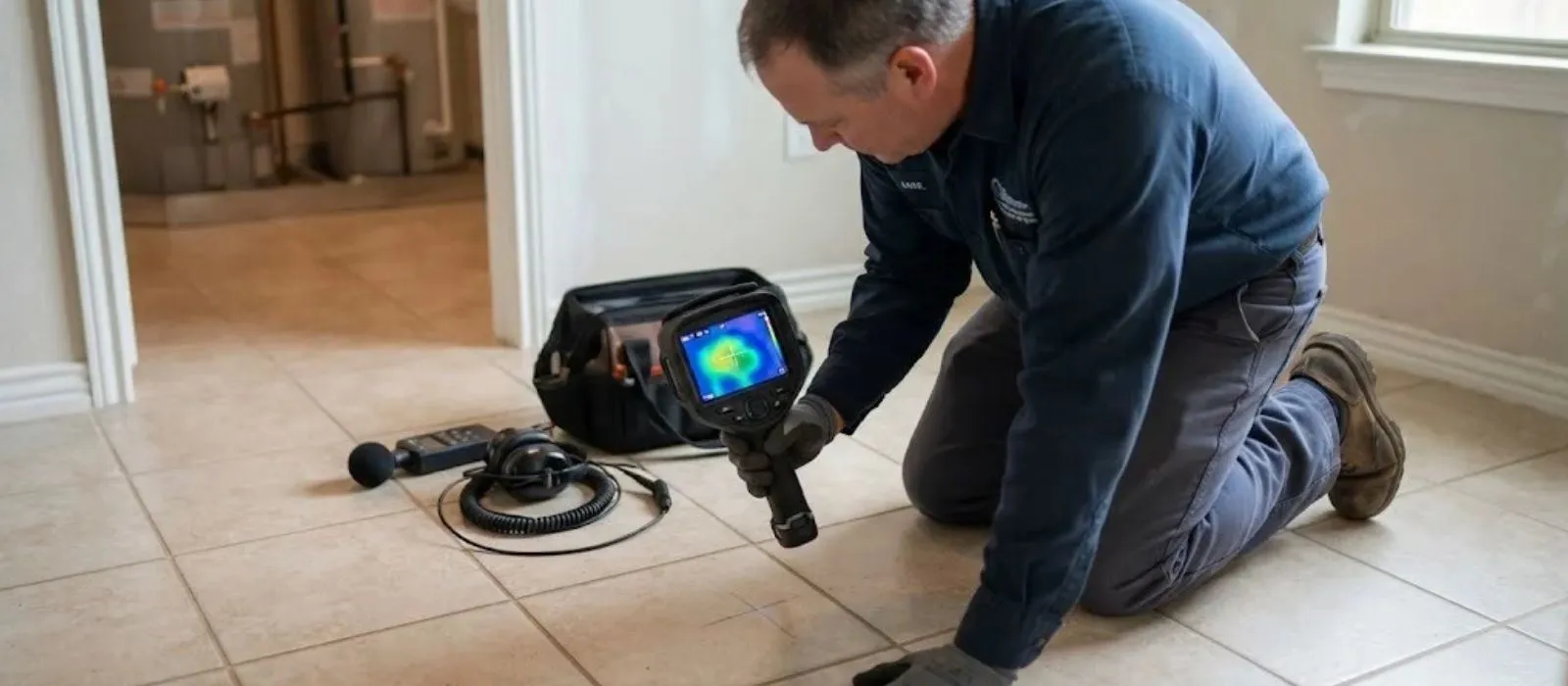
To confirm the spot, a plumber scans the wall with a moisture meter and a thermal camera. A cold, damp patch shows up clearly on the camera. If the reading is still ambiguous, a small inspection hole costs far less than opening a whole wall. Wet drywall that stays damp for days grows mold, so do not wait on a soft section.
The sound of running water under the floor
Many callers describe hearing water run when every tap is off, as if someone were showering beneath the house. That sound is a strong sign of a supply leak in a crawlspace or under a raised floor. Damp insulation, dripping from the subfloor and a musty smell back it up.
Drain leaks hide differently. A leak at the drain below a toilet shows up only after flushing, and the soil under it stays wet long after. Do not go into a wet crawlspace if you see wiring near the water.
Under-floor work is where acoustic listening gear earns its keep, because the pipes are reachable but hard to see. A plumber follows the sound, checks joints and fittings and marks the point. Then the repair is usually a short section, not a whole run of pipe.
Leaks in pipes buried between the meter and the house
A buried line cannot be inspected by eye, so detection is the only way to find the spot. La Mesa gets about 13 inches of rain a year, most of it from November through March. A soft, wet patch in the yard during the dry months, with no sprinkler running nearby, suggests a pressurized pipe is leaking.
Metal pipe carries sound well, while plastic does not. Plastic lines are often found with tracer gas or pressure testing instead. If you suspect this case, see options for repairing or replacing the buried service line.
Sprinkler zones that run too fast or leave soggy patches
A zone that sprays hard, then dies, or one that leaves a mushy strip along the lawn often has a broken head or a cracked lateral line. A valve that does not close fully also lets water creep through all day, which makes the meter move with the timer off.
We isolate each zone, watch the pressure drop on a gauge and mark the failing section. Heads and valves are quick fixes. A cracked buried lateral takes a bit of digging.
Pools, spas and the wet spot by the meter box
If you have a pool or spa, a water level that drops faster than evaporation can explain may mean a leak in the shell or plumbing. A simple bucket test compares the pool level with a bucket of water on the steps. Call us for a pipe-side check once the bucket test shows a loss.
A wet spot right at the meter box could be on the district's side of the meter or on your side. Call Helix first about the meter, then call us if the water is coming from your own pipe.
How the search is done and what each method can miss
No single tool works everywhere. A plumber chooses by pipe material, access and what the symptom suggests.
| Method | What it finds well | Trade-off |
|---|---|---|
| Acoustic listening | Pressurized leaks in metal pipe. | Less reliable on plastic and in noisy areas. |
| Thermal imaging | Hot water leaks and wet patches behind walls. | Shows temperature, so cold leaks need confirming. |
| Moisture meter | Damp drywall, wood and subfloor. | Reads the surface and does not show the exact pipe. |
| Tracer gas | Small leaks in plastic and buried lines. | Needs the line emptied and gas filled, so it takes longer. |
| Pressure testing | Which section of line is losing pressure. | Narrows to a section but not to a single spot. |
Most jobs use two methods together. A pressure test finds the section, and listening or gas finds the point.
Why the cause gets found before any repair is sold
A leak is a symptom. The cause might be a failed fitting, a pipe worn through from corrosion or a line damaged by a dig. Each cause leads to a different repair, so guessing at the fix can mean paying twice.
Ask any plumber for the finding in plain terms: where the leak is, what pipe it is in and why it failed. Then ask for a written price for the repair before work begins. You can check any plumber's license on the California Contractors State License Board site at cslb.ca.gov.
If the same line leaks again and again, patching stops making sense. That is the point to discuss replacing the run, whether you live in La Mesa or in neighboring Lemon Grove.
What changes the cost of finding a leak
The real number depends on the job. These are the things that move it.
How hard the leak is to reach
A pipe behind a bathroom tile wall takes longer than one in an open crawlspace.
Pipe material and depth
Plastic and deep lines need tracer gas or pressure testing, which adds time.
Size of the search area
A single bathroom is a small search. A whole building with several units is a larger one.
Number of methods used
One pass with listening gear costs less than a full sweep with several tools.
Repair and restoration after the find
Detection and repair are priced separately, and drywall or flooring repair is its own work.
Homeowner policies often cover sudden and accidental water damage but often not gradual leaks or wear. Some pay for the cost of opening a wall to reach a covered leak, so ask your insurer before work begins and keep the written finding.
Want your real number? Call (619) 927-0312
Call (619) 927-0312Leak Detection questions answered
Yes. The emergency line is 24/7, including nights and weekends. If water is pouring, close your main valve first, switch off power to wet rooms and then call (619) 927-0312. A plumber can help you keep the damage down until the leak is located.
Turn off every fixture and appliance, then look at the meter's small leak indicator and the dial numbers. If the indicator spins or the numbers change after an hour, water is moving. Closing your own main valve then tells you whether the leak is inside the house or between the meter and the house.
The usual suspects are a toilet that runs after flushing, a cracked buried line and an irrigation valve that does not seal. All of them can leak out of sight. Ask Helix for your usage history, run the meter test and call us if the meter moves with everything off.
Often, yes. Moisture meters, thermal cameras and listening gear narrow a leak to a patch of wall before any cutting. Sometimes one small inspection hole is still needed to see the pipe and confirm the cause.
Call Helix Water District about the meter, the readings and your billing. Call a plumber for anything on the property side, such as pipes in the house, the yard line and the sprinklers. If you are not sure which side the water is on, start with the meter test.
Yes. In a building with several units, the first step is closing each unit's supply valve in turn while watching the meter. That shows which unit or shared line is losing water before anyone opens a wall.
Yes. Finding the leak and fixing it are two decisions. You get a clear price before work starts for each, so you can choose to have the repair done by us or by someone else.
Standards and sources
Leak detection is a method, and each tool follows its maker's instructions for acoustic, moisture and thermal checks. A water meter test with all fixtures off is a common first check.
Helix Water District supplies water to La Mesa, so the meter and the account are Helix matters. Confirm any plumber's license on the Contractors State License Board site, cslb.ca.gov, before work starts.
Leak Detection beyond La Mesa
The same dispatch line covers neighboring towns. Pick yours to see local notes.