
The realistic lifespan range and why it varies so much
Manufacturers usually describe a tankless heater as a 20-year product when it gets regular care. In practice, units that are never flushed in hard-water areas can fail well before that. A neglected heater may need a new heat exchanger or a full replacement in its first decade.
The reason is simple. A tank heater stores water and wears out slowly from rust. A tankless unit heats water on demand through a narrow metal exchanger, and anything that coats or clogs that exchanger forces it to work harder and run hotter.
So the age on the label tells you less than the care history. Two identical units installed the same day can end up ten years apart in remaining life.
What stretches a tankless heater and what shortens it
| Factor | Helps lifespan | Shortens lifespan |
|---|---|---|
| Scale control | Regular flush, softener or filter. | Years of hard water with no service. |
| Inlet screen | Cleaned when you flush. | Clogged with sediment, flow drops. |
| Venting and air. | Clear vent, clean air intake. | Blocked vent, dust, lint in the unit. |
| Usage pattern | Steady daily demand. | Constant short bursts that cycle it. |
| Early repairs | Error code checked quickly. | Codes ignored for months. |
| Installation | Correct gas line size, service valves. | Undersized line, no isolation valves. |
If you are not sure which column describes your unit, a tankless water heater service visit can sort it out and show you what the exchanger looks like.
Warning signs your unit is aging early
Most tankless failures give notice. These are the ones to act on.
Temperature swings
Hot, then lukewarm, then hot again often points to scale on the exchanger or a clogged inlet screen.
Repeated error codes
A code that clears and returns is the heater telling you something is restricted, dirty or failing.
Slower hot water at the tap
A drop in flow can come from a blocked inlet screen, not just a bad pump or valve.
Kettle-like rumbling
Boiling or ticking sounds inside the unit mean water is flashing against scale.
Rising gas use
A scaled exchanger burns more fuel to deliver the same heat.
How a flush is done and what to expect
Shut off power and gas
Turn off the electrical supply, close the gas valve and let the unit cool before touching the service valves.
Close the water isolation valves
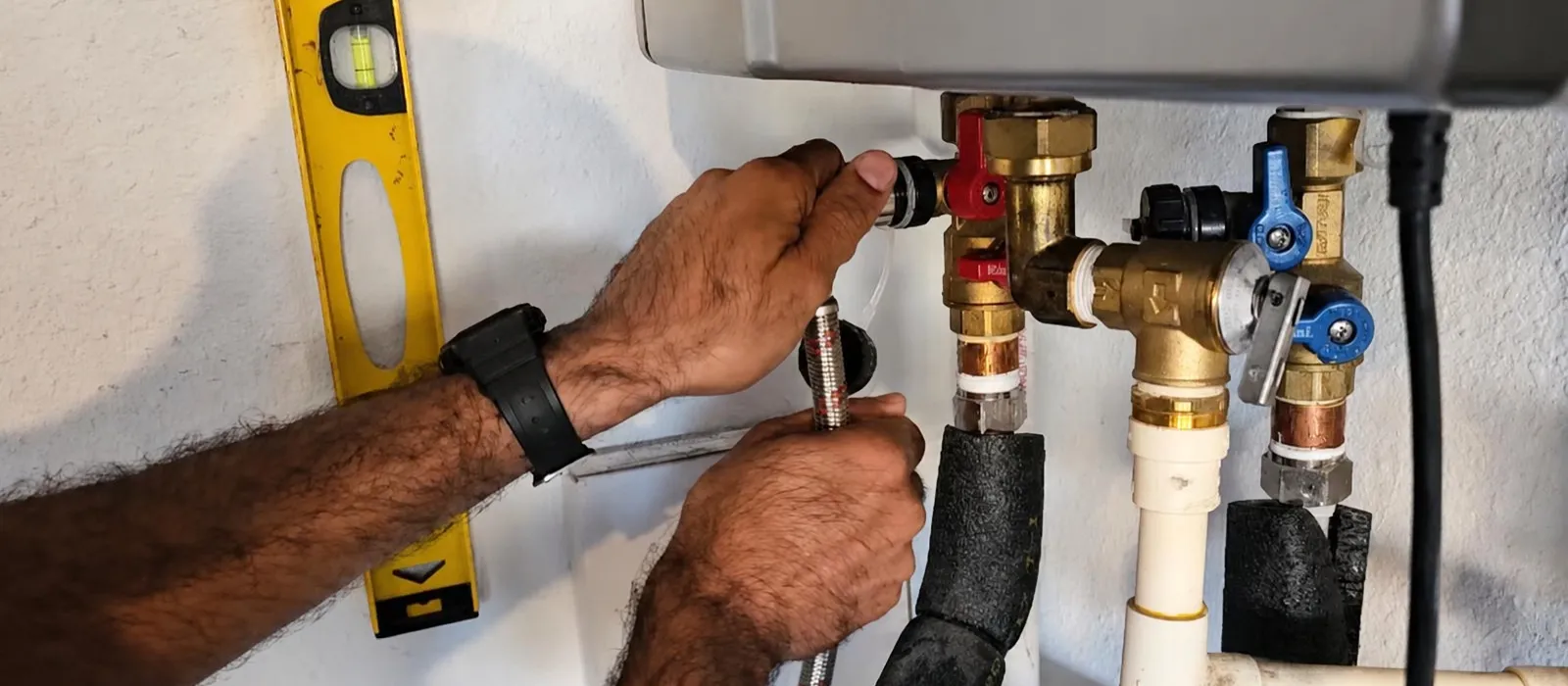
A properly installed unit has hot and cold service valves with ports for hoses. If yours has none, that is a good reason to call.
Connect hoses and a pump
A small submersible pump circulates a descaling solution, often food-grade vinegar, through the exchanger into a bucket and back.
Circulate for the time in your manual
Time depends on how scaled the unit is. Heavy scale takes longer or a repeat pass.
Rinse, clean the filter and restart
Flush the solution out with clean water, pull and rinse the inlet screen, reopen the valves and check for leaks before restoring power.
Flush it or leave it alone
Skipping the flush feels like saving effort. It usually costs more later.
What a regular flush does
- Removes scale before it hardens.
- Restores steady hot water temperature.
- Lets us spot a failing part early.
- Keeps gas use closer to normal.
- Builds a service record for resale.
What skipping it risks
- Scale that vinegar can no longer dissolve.
- Overheating and nuisance shutdowns.
- A cracked or restricted heat exchanger.
- A repair bill that outruns the unit's value.
- Earlier replacement.
When to repair, when to replace
Repair makes sense when the unit is under about 12 years old, the exchanger is sound and the fault is a sensor, igniter, fan or inlet screen. Replace when the exchanger leaks, the heater is near 20 years or a repair would cost close to a new unit.
If your system is a candidate for retirement, we can walk through options for replacing an aging unit with a new one and size it to the fixtures you actually run at once.
Not sure the real issue is the heater? A cracked fitting or failing valve nearby can mimic a failing exchanger, so we check the water connections before condemning the unit.
Pairing a tankless heater with treatment
A softener removes the minerals that build scale in the first place. For a tankless heater, that can mean fewer flushes and a longer exchanger life. It adds a maintenance item of its own, so the trade is real.
If scale is your main enemy, ask about a softener or filter matched to your water before you buy a premium heater. A cheap unit with treatment may outlast a premium unit with none.
Homeowners in Spring Valley and El Cajon share the same Helix supply, so the same hard-water logic applies across those communities.
What decides the cost of tankless service
We do not post numbers in a blog. You get a written price before work starts. These are the factors.
Service versus repair
A flush is a defined visit. A repair depends on which part failed.
Scale level
Heavy scale takes longer and may need more than one pass.
Installation quality
Missing service valves or a tight install adds labor.
Brand and parts availability
Some parts are stock items. Others must be ordered.
Venting and gas work
Vent or gas line corrections change the scope.
Homeowner policies often cover sudden and accidental damage but often not wear or gradual leaks, so ask your insurer about your coverage.
Want your real number? Call (619) 927-0312
Call (619) 927-0312What La Mesa homeowners should know about hard water
Helix Water District reported that its 2025 water averaged 206 mg/L hardness, which is 12.0 grains per gallon. The reported range ran from 9.1 to 14.6 grains per gallon. On the common USGS scale, anything over 180 mg/L is very hard, so even the low end of that range leaves scale behind inside a heat exchanger.
That is why we treat flushing as a yearly habit, not an occasional fix. Hardness can vary from one street to the next, so check your own tap or ask Helix. If your supply is near the top of the range, move the flush earlier. If the unit has gone more than a year, plan the flush sooner rather than later, and clean the inlet screen at the same visit.
The tie-back is easy to measure: if hot water temperature is steady and the error codes stay quiet after a flush, your interval is about right. If scale returns fast, add treatment.
Sources used: Helix Water District 2025 Annual Water Quality Report. Plumbing work in California follows the California Plumbing Code, which is based on the Uniform Plumbing Code (UPC).
Quick answers
Many manufacturers suggest about once a year in hard water, and some say more often when the supply is very hard. Follow your manual, then adjust: if the inlet screen is full of grit or the unit shows scale codes, shorten the interval.
If your unit has service valves and you are comfortable with hoses, a pump and a bucket, many owners do. The risk is skipping the shutoff steps or missing a leak at the valves. If anything seems off, call us.
Usually, yes, because there is no tank to rust through. The exchanger is the part that matters, and scale is its enemy. A tank heater often lasts 8 to 12 years while a cared-for tankless unit can run much longer.
Not always. Heavy scale may need multiple passes. If the exchanger is cracked or leaks, flushing will not help and replacement is the honest answer.
It depends on the brand. Common causes are restricted flow, venting problems, ignition faults or overheating from scale. Write the code down and call so we can match it to the model.
Helix reported very hard water, with a 206 mg/L average, so scale control matters. Start with a yearly flush, then shorten the interval if your inlet screen or the first flush shows heavy buildup.