
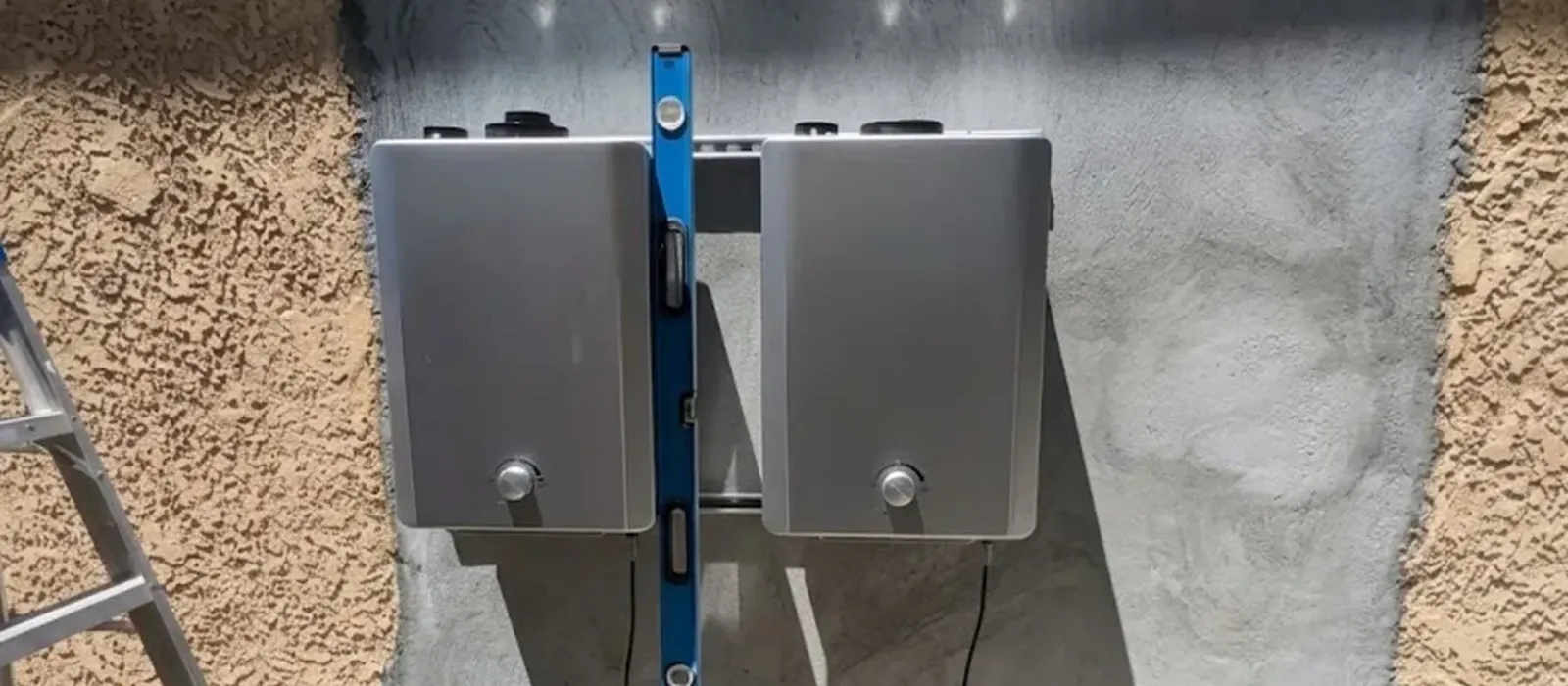
Can a tankless unit go outside?
Yes, but only models listed for outdoor use. These units have a weather-resistant cabinet, a built-in vent cap and controls sealed against rain. An indoor-rated unit set outdoors will rust, trip errors and may violate its listing.
Outdoor placement keeps the vent short and removes the need for a flue through the roof or wall. It also keeps the noise and heat outside the house. The tradeoffs are exposure, longer hot water pipe runs, and the need to protect lines from sun and cold.
How an outdoor tankless install is planned and done
Pick the wall and clear space
Choose a firm exterior wall or a pad. Check the maker's clearances to windows, doors, vents, eaves and the property line. The unit needs room to breathe and room to service.
Size the gas and water lines
Tankless units draw a large gas load all at once. The existing gas line may need to be upsized. Water lines need shutoff and service valves on both sides of the unit.
Mount and level the unit
The unit is fastened to the wall or pad. A level cabinet helps drain condensate and keeps burners stable.
Connect gas, water, power and condensate
Gas, hot and cold lines, an electrical outlet or circuit and a condensate line for condensing models are connected. Each joint is tested for leaks.
Insulate, cover and test
Exposed pipes get insulation and a cover. The unit is started, flow rate and temperature are checked, and error codes are cleared.
Outdoor placement checks at a glance
| Check | Why it matters | What to ask |
|---|---|---|
| Clearances | Safe combustion and service access. | What distances does the maker require? |
| Gas line size. | The unit starves if the line is too small. | Is the line sized for the full load? |
| Condensate | Acidic water must drain safely. | Where does it go, and is it neutralized? |
| Pipe protection | Sun and cold damage exposed pipe. | What insulation and cover will be used? |
| Service access | A tight spot makes repairs slow. | Can the cabinet and valves be reached? |
Weather, sun and noise: what outdoor exposure means
Rain and moisture
An outdoor-rated cabinet sheds rain. Keep sprinklers from spraying the unit and keep mulch and soil away from the base.
Sun and heat
Direct sun can bake plastic, fade labels and dry out seals on exposed pipes. A shaded wall or a pipe cover helps.
Freeze protection
Most outdoor units have built-in heaters and drain-down features, but each has a rating. Read the maker's low temperature limit and match it to your area.
Noise
A running burner and fan make some sound. Do not mount the unit under a bedroom window.
Pests
Insects and rodents like warm cabinets. Keep vents screened per the maker's directions.
Venting, condensate and gas line sizing
Outdoor units use a built-in vent, so there is no long flue to build. Still, the discharge needs clearance from windows, doors and walls. Follow the maker's chart. Do not box the unit into a closet or cover it with a fence or lattice that blocks airflow.
Condensing models produce acidic condensate. It needs a drain line to a proper location, often through a neutralizer. Do not let it run onto a patio or into a planter bed. The gas line is the other big item. A tankless heater can use many times the gas of a tank burner when it fires, so the meter, regulator and pipe diameter all matter.
Outside or inside: which fits your house
Outdoor install
- Saves indoor wall and closet space.
- Short vent and fresh combustion air.
- Exposed to rain, sun and pests.
- Needs pipe insulation and a cover.
- Longer wait for hot water if far from taps.
Indoor install
- Protected from weather.
- Needs a vent through the wall or roof.
- Takes up interior wall space.
- Shorter pipe runs in a central spot.
- Noise and heat stay in the house.
Pipe runs, wait time and wasted water
The farther the unit sits from your taps, the longer the wait for hot water, because the cold water in the pipe has to drain first. An outdoor unit on the far side of the lot can mean a long run through a wall or crawlspace. Pick the wall closest to the kitchen and bathrooms when you can.
A recirculation loop or a small buffer tank can cut the wait but adds parts and power use. Ask your plumber to map the pipe route on paper before the unit is set, and to price insulation for the entire exposed run.
Maintenance access and long-term care
A tankless unit needs yearly care. The water filter screen should be cleaned, and the heat exchanger flushed with a descaling solution on a schedule. If the unit is boxed in or hung high, this work becomes harder and gets skipped.
Plan a clear path with room for a ladder or work stand. Label the shutoff valves and record the model number and install date. A homeowner can clean the intake screen. Gas work and heat exchanger service should be left to a licensed plumber.
Confirm that the model is listed for outdoor use, that the cabinet has the right rating for your site and that the warranty does not exclude your install. Permit rules vary, so ask City of La Mesa building staff before work starts.
When to call a plumber
Gas, venting and condensate are not do-it-yourself jobs. Our licensed plumbers handle tankless water heater installation and service and sizing work, along with water heater installation on outdoor walls when you are comparing designs. Service covers El Cajon and Spring Valley as well.
If you smell gas, leave the building and call San Diego Gas and Electric or 911 before you call a plumber. For planning, call (619) 927-0312. The real number comes as a written price before work starts. It depends on unit model, wall or pad prep, gas line size, pipe length, condensate drainage and weather protection.
What La Mesa weather means for an outdoor unit
La Mesa winter average highs run 66 to 77 F, and summer average highs run 78 to 92 F. That is mild compared with many places, but it does not remove the need for an outdoor-rated unit. Choose a model built for outdoor use and cover exposed pipes, since sun and temperature swings can harm bare lines.
The city gets about 13 inches of rain a year, mostly November through March. Rain-proof cabinets, sealed connections and a clear drain path matter most in those months. Overnight lows are not in our sources, so check the maker's freeze protection ratings and match them to your own site before you decide.
Sources used: La Mesa climate data, manufacturer practice, general plumbing practice. Plumbing work in California follows the California Plumbing Code, which is based on the Uniform Plumbing Code (UPC).
Quick answers
Yes. Use a model that is listed for outdoor installation. It has a sealed cabinet and a built-in vent suited to rain. An indoor model outdoors can fail early and may void the warranty.
It can if the temperature drops below the maker's limit. Many outdoor units have built-in freeze protection that needs power. Check the rating and protect exposed pipes.
The maker sets the distance, and local rules may add more. Ask your plumber to read the clearance chart for your exact model before choosing the wall.
Yes. Condensing models create acidic condensate that must drain to an approved spot, often with a neutralizer. Do not let it run onto the ground by the wall.
No. Sun, rain and temperature swings still age bare pipe and fittings. Winter highs here average 66 to 77 F, but overnight lows are not in our data. Insulate and cover exposed lines and read the unit's freeze rating.