
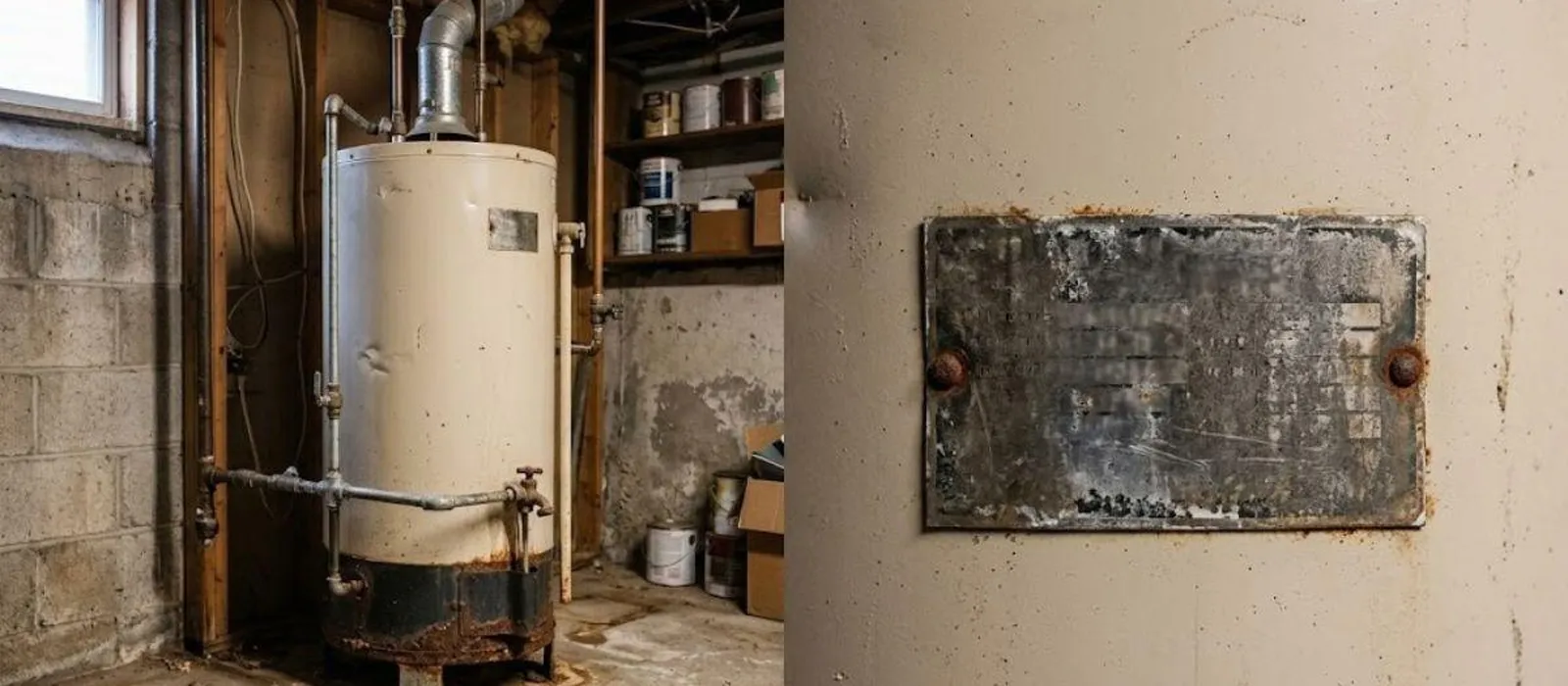
What a Honeywell part does on your water heater
Honeywell makes the combination gas control that sits on the lower front of many gas tank water heaters. It is the box with the temperature dial, the pilot knob and the gas line feeding into it. It does three jobs: it holds the pilot, it opens the main burner when the tank cools, and it shuts everything off if the flame goes out.
A small sensor sits in the pilot flame. On older units it is a thermocouple, a copper-tipped rod that makes a tiny current when hot. On many newer units it is a thermopile, which makes more power and runs the valve. When the sensor cools, the valve closes the gas.
That design is why one weak part can leave you with no hot water. It is also why the heater fails safe.
Match what you see to the likely part
Most calls we hear fall into a handful of patterns. Find yours before you touch anything.
Pilot lights, then dies when you let go
This points to a weak thermocouple, a dirty pilot tube or a flame that is too small to heat the sensor.
Pilot stays lit, burner never fires
Suspect the thermostat side of the gas control, a failed thermopile, or a valve that is not opening.
Water too hot or too cold
The dial may be set wrong, or the temperature sensing in the valve has drifted. Compare the dial to a kitchen thermometer reading.
Burner roars or flame is yellow and lazy
Check for dust at the burner air intake. Heavy soot or a yellow flame is a stop-and-call situation.
Rumbling or popping from the tank
That is usually scale in the tank bottom, not the valve. Replacing the control will not cure it.
Checks you can do safely before you call
Read the dial and the gas knob
Confirm the knob is on Pilot or On, not Off, and the dial is not set to the lowest mark. A bumped dial explains many no-hot-water calls.
Look through the sight window
If you can see a steady blue flame at the pilot, the sensor is probably the issue. If there is no flame, follow the relight label on the tank.
Relight only if you smell no gas
Follow the instructions printed on the heater. If the pilot will not hold after two careful tries, stop. Repeating it only wastes time and can pool gas.
Check the vent area and the floor
Look for soot marks above the draft hood and for water pooling at the base. Either one changes the diagnosis.
Write down the label details
Note the model number, capacity and age on the tank label. It tells us if the part is worth replacing before we arrive.
If you smell gas near the water heater
A gas smell outranks every repair question on this page. Our line is open 24/7, but the first call is not to us.
Leave the building with everyone in it and call the gas utility, which in San Diego County is San Diego Gas and Electric, or call 911. Make that call from outside or from a neighbor's home. Call a plumber only after the utility says the area is safe.
- Walk out now and take people and pets with you.
- Do not flip light switches, use a lighter or start a car in the garage.
- Do not try to relight the pilot.
- Call the gas utility or 911 from outside.
- Call us after the utility clears the home so we can inspect the heater.
Replace the Honeywell control or replace the heater
The part is only half the question. The tank it is bolted to decides whether the repair makes sense.
A control repair usually makes sense when
- The tank is dry and the base is clean.
- The heater is under about eight years old.
- The anode rod and tank condition look decent.
- The fault is a pilot sensor or a stuck dial.
- There is no rust at the burner chamber.
Replacement usually makes sense when
- Water seeps from the tank seam or base.
- The unit is past 10 to 12 years.
- Rust flakes fall into the burner area.
- The same fault returns after a new part.
- The tank is rumbling from heavy scale.
Fault, likely cause and who should handle it
| What you notice | Likely cause | Next move |
|---|---|---|
| Pilot will not stay lit. | Worn thermocouple or dirty pilot tube. | Plumber visit, gas work. |
| No hot water, pilot on. | Thermopile or valve not opening. | Plumber visit, gas work. |
| Water far too hot. | Dial setting or drifting sensor. | Lower the dial, then call. |
| Water on the floor. | Tank leak or fitting leak. | Shut off the cold supply, then call. |
| Smell of gas. | Leak at fitting, valve or line. | Leave, call gas utility or 911. |
| Popping from tank. | Scale layer on tank bottom. | Flush or plan replacement. |
If the unit is old and the symptoms stack up, the decision table points toward replacing the whole tank heater instead of paying for a part that outlives the tank.
When the Honeywell part is not the real problem
People often blame the control because it is the visible gadget. The tank is the part that actually wears out. A steel tank with a failed anode rod rusts from the inside, and once a seam weeps there is no repair for it.
If water collects around the base, look closely before you assume the valve. The same check applies whether you live in El Cajon or Lemon Grove. A drip from the temperature and pressure relief valve line, a loose cold inlet fitting or condensation can all look alike. A real tank leak needs the cold supply shut off and a plan to swap the unit.
Age matters too. On a heater around 10 years old, a new control can cost more in service than it adds in life. We will tell you plainly when the repair is a poor bet, and the written price comes before any work begins.
For a gas tank heater with a valid fault, our team handles water heater repair on gas control valves and pilot assemblies and tests the burner, venting and shutoff before leaving.
What drives the cost of a gas control repair
We do not quote numbers from a blog. The real number is a written price you see before work starts. These are the factors that move it.
Which part failed
A thermocouple is a small part. A full gas control valve is a larger part and more labor.
Heater age and condition
A sound tank justifies a new valve. A rusty tank may not.
Access and venting
Tight closets, long vent runs and attic units add time.
Gas line and fitting condition
Old unions or a corroded flex connector may need replacing at the same visit.
Timing
After-hours work differs from a planned daytime appointment.
Homeowner policies often cover sudden and accidental water damage but often not wear or a slow leak, so ask your insurer before you file.
Want your real number? Call (619) 927-0312
Call (619) 927-0312What La Mesa homeowners should know
Helix Water District reported very hard water for 2025, with an average of 206 mg/L, which is 12.0 grains per gallon. Hard water leaves scale on the tank bottom, right where the burner heats. That layer insulates the water from the flame, so the burner runs longer and the control sees odd readings. If you hear popping and your valve keeps tripping, ask for a tank flush and check before blaming the valve.
California Health and Safety Code section 19211 requires water heaters to be braced, anchored or strapped against falling or sliding in an earthquake. Burner and control work involves moving and tipping parts around the unit. After any service, look at the strap and confirm it is snug and attached to the wall. We check it when we are there, and you can check it too.
Sources used: Helix Water District 2025 Annual Water Quality Report, California Health and Safety Code section 19211. Plumbing work in California follows the California Plumbing Code, which is based on the Uniform Plumbing Code (UPC).
Quick answers
The most common reason is a worn thermocouple that no longer senses the flame. A pilot tube clogged with dust, a draft at the burner or a weak gas supply to the pilot can do the same. If the pilot will not hold after two careful relight attempts, stop and call for service.
We advise against it. The valve connects to the gas line and controls combustion, and a poor seal or wrong part is a fire and carbon monoxide risk. Sensors are simpler, but the safe test after the swap is the part that matters.
Look for moisture at the base, rust-colored water, rust flakes at the burner chamber and a heater past 10 years. A leaking tank cannot be repaired. Shut off the cold supply and call.
Yes, our emergency line runs 24/7 for active leaks and no-heat calls. For a gas smell, though, leave and call the gas utility or 911 first.
Helix reported very hard water, so scale builds on the tank bottom of a gas heater and can make it noisy, slower and harder on the burner. A periodic flush and anode check slows that down. Hardness can vary by street, so test your own tap.